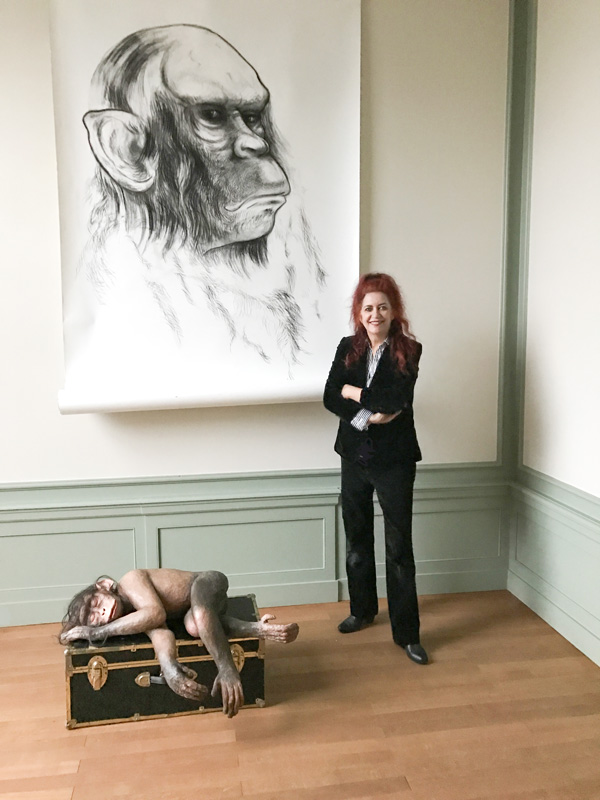
Over the past few years, Groenendijk’s monkeys have evolved into ever more human-like creatures. The prominent dark brown of early pieces has given way to fleshy pink skin-tones. The anatomies have come to display anthropoid proportions and the use of human hair increases an uneasy sense of kinship with her figures. Yet, unlike other contemporary artists working with the monkey figure, Groenendijk doesn’t rely on a hyper-realistic visual language. She prefers a rough finish for her pieces and does not use popular materials among fellow figurative sculptors such as wax, resin or silicone. Likewise she doesn’t seek with her work to offer a representation of the animal or predatory side of men – a fatalistic view on human nature that often leads to sensationalistic kinds of artistic propositions. Neither blood-drenched sceneries nor barbaric encounters are to be found in her extensive body of work. Groenendijk’s interest in the power of the monkey metaphor to address existential questions does not so much focus on violence and survival as it does on the possibility of redemption and change.
Ready presents us with a monkey-girl holding the shoes she will need to go on for yet another day of school or, maybe, for a journey to the unknown. The adult monkey in Time is on my side is already on his way. A multitude of clocks is hanging from his backpack. Time is both an adversary and one’s most precious assets. In Back in Time, a tiny monkey sits on a book, transported to the past, while Darling, the baby monkey, faces the future all smiles.
There is a sense of innocence, lost and recovered, to these works. Time plays a decisive part in them and it could be said that this particular group of sculptures constitutes something of a contemporary adaptation of the genre of the Vanitas in the fine arts. The presence of objects traditionally symbolic of earthly pleasures and accomplishments, such as books and scientific instruments, could easily mislead one to understand these sculptures in terms of a warning about the inevitability of death and the transience – and vanity – of mundane values.
Groenendijk would most surely be unwilling to make such a decisive statement. Her sculptures are imbued with a playfulness that bespeaks the possibility of happiness in this world. The seventeenth century belief in the existence of an afterlife gives way in Groenendijk’s work to an admonition to start looking at the bright side of things – right here, right now.
A second group, which emerges from the variety of Groenendijk’s latest series, is one that could be labelled ‘the sleepers.’ Whereas the sculptures mentioned above intimate the urgency of transformation, the variations on Mary’s Daughter all feature slumbering figures. As if stricken by an unbidden fatigue, they have carelessly fallen asleep while still holding their sheets.
The poses, gestures and facial expressions emphasize the idea of surrender so as do their nakedness and scarce hair, which add to their vulnerability. Groenendijk’s ‘sleepers’ do not merely represent the act of sleeping; they offer an embodied vision of such notions as appeasement and abandon.
Groenendijk’s series of ‘sleepers’ and what could be named her ‘time-travellers’, described above, constitute the complementary sides of one and the same coin. Both these groups of manlike monkey sculptures call attention to the necessity of ‘letting go’ whether it is by way of surrendering or by way of changing. They constitute as many allegories of these different forms of freedom – the ultimate symbol of the possibility of redemption.